



CFO's
review
Normalising growth after the COVID pandemic with investment into organic growth for the future!
The 2022 financial year has been the year of two halves with the first half being impacted by once off vaccination programme investment of R25 million and the impact of non-adherence to chronic medicine of R22 million. The Group has however neutralised the impact of non-adherence to chronic medicine towards the end of the second half of our financial year. The second half was impacted by geopolitical tensions which led to higher inflation and rising interest rates across the globe. Despite some of these changes that have had an impact on the Group's results, the Group has continued to grow.
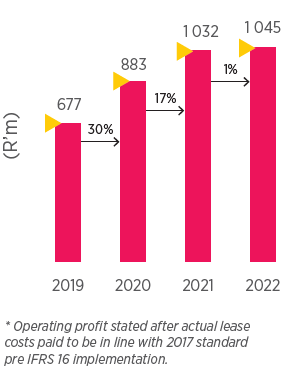
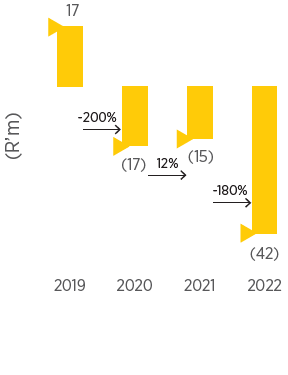
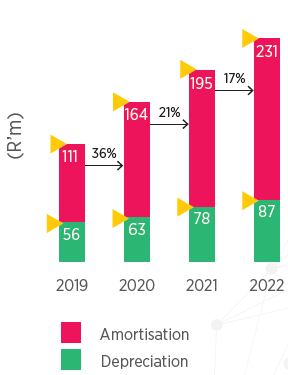
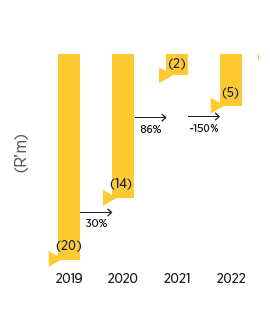
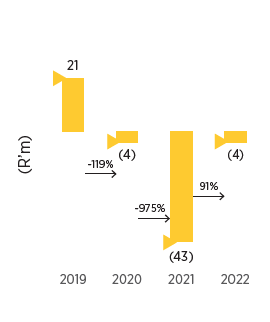
Four-year summary of Profit before tax
Operating profit*
Net cash finance income/loss
Depreciation/amortisation

IFRS 16 (Leases) net effect
Other (impairments, share based payments)
Profit before tax
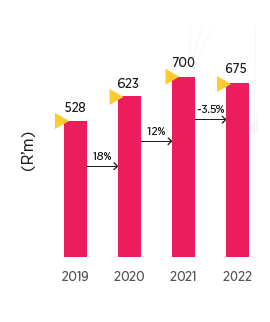
During the 2022 financial year, AfroCentric invested in the digitisation of the Group, as well as in new product initiatives. The implementation of these initiatives has resulted in the Group incurring once off costs, which will be fully realised through improved operational efficiencies in the short to medium term. Pursuant to this investment, the operating growth increased by 1.2% while the Profit before tax decreased by 3.5%. The profit before tax was further impacted by the increased depreciation and amortisation in the 2022 financial year. The Group’s strategy of diversifying its product offering by investing in the value chain of healthcare services has been the main reason for increased amortisation over the past few years, with significant acquisitions like Activo Health in 2019, DENIS in 2020, and Forrester Pharma in 2022. The investment in our internally developed administration system during 2015 to 2018 (with final implementation in the 2019 year) has also contributed to enhanced amortisation.
The above acquisitions have resulted in growth in the pharmaceutical cluster in excess of 10% while the efficiency in which the Medscheme South Africa business is managing its clients is improving operating profit, therefore remaining stable in a period of declining membership in South Africa due to macroeconomic factors.
Healthcare Services Financial Performance
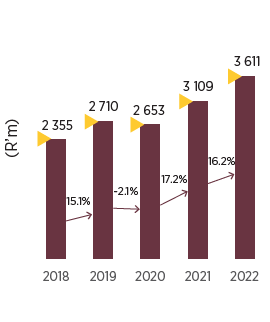
The traditional medical scheme administration and managed care businesses that mainly consist of Medscheme have consistently been exceeding expectations in operating profit due to the difficult market conditions they operate in. With limited growth in insured lives in South Africa, the Medscheme membership has been able to retain its membership base consistently in the four largest schemes we manage, namely, Bonitas, Fedhealth, Polmed and GEMS. In the past 12 months, we have recorded net growth in both Bonitas and GEMS which indicates the commitment the public still have for private healthcare benefits and that the South African middle class has not been impacted too harshly by the reduction in employment.
The focus for Medscheme, being the primary subsidiary of the Group responsible for medical scheme administration, has been to build systems and processes of excellence. This entailed embarking on projects where teams compete on a "Single Service Measure" enabled competition in the business units that resulted in improved customer service and turnaround time of transactions. The rollout of other digital enhancements in the member applications, WhatsApp communication and chatbots have also driven more customer volumes to a digital platform that is 24/7 enabled and reliable. An improved hospital approval system linked to the major hospital groups in South Africa will further enhance the turnaround time, case management and payment cycles of hospital claims and thereby reducing transaction costs for this particular service.
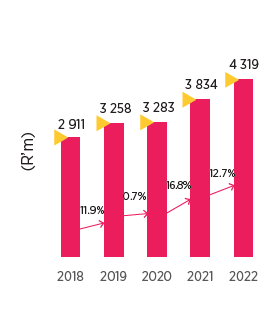
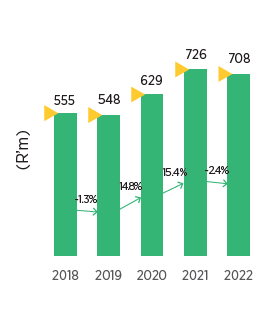
With this investment in digitalisation, the cluster's operating profit decreased slightly by 2.4%.
Revenue
Operating costs
Operating profit
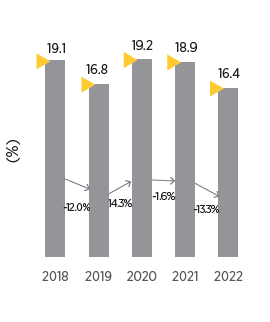
Operating margin
Healthcare Retail Financial Performance (Pharmaceutical)
The Pharmaceutical division has continued its expected growth trajectory during 2022, however, this was dampened by the sales of preventative medicine that retracted to pre-COVID-19 levels, reduced script performance due to non-adherence to the renewal of chronic medicine scripts, the slower than anticipated progress on the oncology product line, and price pressure to reduce the single-exit price. Encouragingly, the reduction in the private portfolio script performance has been offset by an increase in the National Department of Health (NDoH) script performance.
Revenue
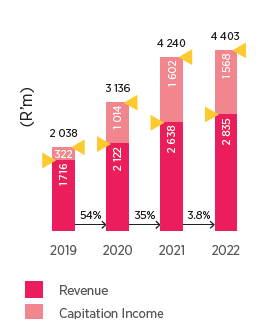
Operating costs
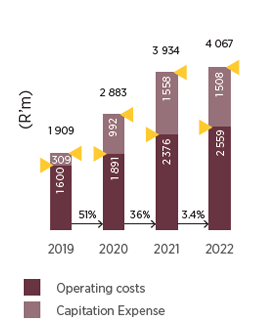
Operating profit
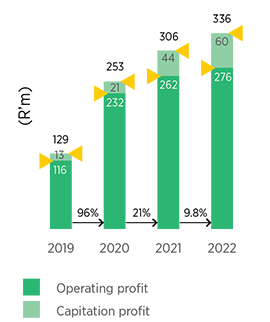
Operating margin (%) (excluding Capitation Income)

Pharmacy Direct continued its script growth during the year and consistently delivered in excess of 1 million chronic scripts to public patients, while the private medical scheme script count retracted to 142 842 (2021: 169 022) per month. The improved operating profit was, however, not only due to increased volumes, but was also as a result of improved cost efficiencies in the packing and distribution of medicine. In the latter part of the year, a new robotics system has been installed in the private side of the business and will yield significant returns in the 2023 financial year.
Capital management
The Group has experienced some significant turnarounds in its balance sheet since 2015 by first having excessive cash on hand with the subscription of shares sale to Sanlam and the issue of additional shares that funded the initial pharmaceutical assets. These new businesses, compared to a stable cash generating medical scheme administration business, have required the management team to look at different ways in which growth can be supported. For this very reason, the Group has continued to rather fund acquisitions through debt since 2019, as no gearing was in place then, and the continued working capital needs are being monitored and reviewed on a weekly basis, with targets set for each unique business.
These trends of acquisitive growth are the main drivers of significant movements in our statement of financial position at 30 June 2022 as set out below.
Significant movements

Optimising our Capital Structure while absorbing new acquisitive opportunities is a balancing act.
The Forrester acquisition in August 2021 was the main contributor to the increase in Goodwill, Intangible Assets, and Contingent consideration liability.
The objective of matching capital expenditure incurred with regards to IT development and matching it with amortisation is starting to pay off and, therefore, the increase in intangible assets is mostly attributed to the customer relationships, arising from the purchase price allocation of the DENIS and Forrester acquisitions.
Inventory (R'm)
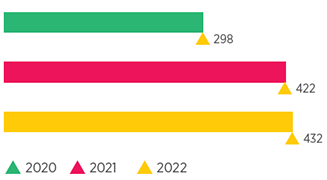
Trade receivables (R'm)
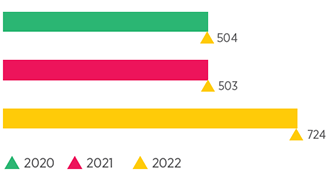
Trade payables (R'm)
Net working capital (R'm)
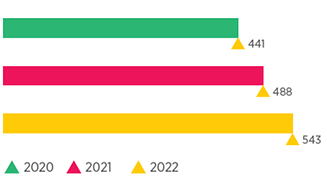
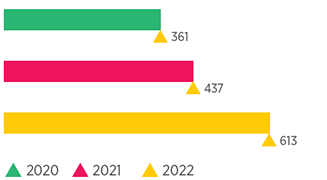
The Group has had a good cash generating ability over the last 18 months which covered working capital, acquisitions and shareholder needs. Some of this cash was invested in our short-term borrowing at year-end which shows a decline even though the Forrester acquisition was funded through it. Cash generation is key to the AfroCentric Group and forms the foundation of delivering a satisfactory dividend to our shareholders while being able to fund new Group initiatives through its working capital.
Working capital, as depicted above, has grown, especially inventory, but if the excess inventory as a result of new product launches (slow moving in first two years of launch) is excluded, the inventory levels have actually been managed down from prior years and with cognisance of the growth experienced.
Conclusion
AfroCentric has a proven track record of acquiring new businesses and integrating new businesses products in a seamless way to provide customers with a continuous experience in healthcare services and products. This philosophy will continue and while we are at the end of a period of acquisitions, the organic growth opportunities will now be the focus for further expansion.
The optimal capital structure of equity, debt and working capital balanced by a reasonable dividend policy is continuously being reviewed to ensure the sustainability of earnings of the Group and returns for our shareholders.
I would like to thank the Group Finance team for its dedicated hard work and commitment to consistently being innovative in support to the Group from a financial and commercial level, of which we reap the benefits, as evidenced by the results recorded.
Hannes Boonzaaier
Group CFO