



OUR SOCIAL IMPACT
TRANSFORMATION
The Group views transformation as a strategic objective that enables the Group to drive towards achieving sustainable healthcare. The Transformation Committee is responsible for driving transformation and BEE compliance across the Group.
Transformation Committee’s key objectives:
- Track and report performance against the Broad-Based Black Economic Empowerment (“B-BBEE”) scorecard
- Identify any risk, its cause, and then agree on an action plan to remedy the out-of-line situation
- Measure performance against key competitors and industry
- Report back on implemented initiatives and projects, progress and whether the initiatives assist us in achieving our transformation objectives
- Monitor compliance and effectiveness of projects aimed at driving transformation
- Monitor transformation and empowerment requirements as specified by current and prospective clients
- Drive transformation and empowerment sector-specific initiatives
- Ensure policies and procedures with regards to the five B-BBEE elements, are documented and adhered to
- Ensure Preferential Procurement practices are consistently aligned to B-BBEE imperatives
- Ensuring a coordinated framework within which the Group will support small, medium and micro-sized enterprise (“SMME”) development, with particular focus on the empowering status of its suppliers in relation to its own procurement activities
- Focus on the promotion of partnerships within the Group in order to achieve B-BBEE priority objectives, with emphasis on skills development, employment equity, enterprise and supplier development and ownership
TRANSFORMATION COMMITTEE MEMBERS
The Transformation Committee comprises senior individuals across all disciplines of business, tasked with driving the different pillars of the B-BBEE scorecard.
THE NATIONAL EMPLOYMENT EQUITY FORUM
The National Employment Equity Forum (“NEEF”) is responsible for driving employment equity compliance in the Company. The qorum is represented by employees, management and union representatives and discusses the Company’s statistics, performance towards the employment equity (“EE”) targets, the effects of attrition, promotions and recruitment on the targets.
The forum is further supported by sub-committees which represent the different business units. Information discussed and presented at the NEEF is used as input into the transformation committee.
SOCIOECONOMIC DEVELOPMENT
THE SED TEAM ARE RESPONSIBLE FOR:
Vetting proposals in order to determine whether the proposed projects:
- will enable the Group to reach the objectives of transformation strategy, B-BBEE and 10-point plan on Health;
- fall into the priority areas of health, youth development, HIV/ Aids, as specified in the SED policy;
- are in line with the Group’s brand integrity and can be used to strengthen AfroCentric’s brand; and
- have initiatives that focus on the upliftment of the communities in which we operate, and partnering with existing NGOs in the healthcare sector to assist with the betterment of the quality of life and supporting their needs on an ongoing basis.
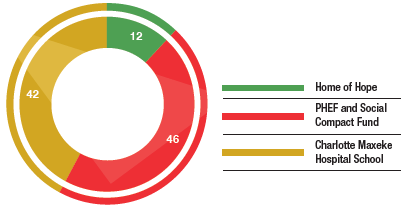
| SED SPEND (Rs) – FY 2015/16 | SED SPEND (Rs) – FY 2016/17 | |
 |
 |
CURRENT SOCIOECONOMIC DEVELOPMENT PROJECTS
The projects are set in line with the allocated budget, the target being the equivalent to 1% of net profit after tax (“NPAT”). A “hit and run” approach is inappropriate for achieving long lasting impact. In line with our belief towards the beneficiaries, we select a few flagship projects that we channel a significant portion of our budget to over a period of three to five years.
The key projects in the 2017 reporting period include:
- The Social Compact Fund – In November 2012, we became signatories to the fund, thereby committing to contribute a significant portion of our SED budget to the fund. The Social compact has been set up by Minister of Health, to pool resources from companies working in the health sector, and use these resources to give momentum to some of the key objectives of the 10-point plan on Health. The fund is expected to provide financial support to Government to take in more medical students; support postgraduate students pursuing health-related studies; build additional capacity in the management of Tuberculosis (“TB”); and provide support to the newly established Leadership and Management academy for health.
- Charlotte Maxeke Johannesburg Hospital School – The school educates hospitalised children and teenagers in grades R to 12. Although many of the children are undergoing long-term treatment for terminal, chronic and life-threatening illnesses, they are able to learn in a stimulating, cheerful environment, giving them a welcome break from their medical treatment and their confinement in hospital wards. AfroCentric Health funded the complete refurbishment and equipping of the hospital school and computer centre, and sponsored the installation of a custom-designed playground, which provides a safe environment for children with impaired immune systems.
- Home of Hope for Girls – The home provides real care for exploited, trafficked and abused girls in Johannesburg. It is more than just a residential shelter; it is a home where dignity is restored, the past is healed and the girls are given the tools to take control of their futures. Home of Hope for Girls also reaches out to the community offering the most vulnerable members support, practical help and a lifeline. AfroCentric has funded towards the children’s educational needs.
ENTERPRISE AND SUPPLIER DEVELOPMENT COMMITTEE
This committee is responsible for the identification of suitably qualifying projects that meet the requirement for enterprise and supplier development recognition. The projects are identified, approved, implemented and driven to completion by the committee members. The committee further provides any additional support, e.g. Business skills, business and/or training equipment, cash investments, etc.
The Enterprise and Supplier Development (“ESD”) Committee adopts the approach that a long-standing partnership between the company and the beneficiary leads to a long-lasting impact on the beneficiaries. This approach enables the measurement of progress and growth of the beneficiary organisation.
ENTERPRISE SUPPLIER DEVELOPMENT INITIATIVES 2016/17
Our ESD beneficiaries include:
| Entity | Description | |||||
| Behaviour Change Agency (PTY) LTD | A specialist agency that incorporates behavioural science, predictive analysis and creative communication expertise to design change strategies and marketing solutions. | |||||
| Econocare (PTY) LTD | A business management service provider established to assist black entrepreneurs in the healthcare sector i.e clinics, diagnostic centres, laboratories and medical centres to start or grow their businesses. | |||||
 |
Eluthandweni Maternity Services | Eluthandweni Maternity Services is a community healthcare centre based in the Ekurhuleni. The clinic aims to provide accessible holistic maternal healthcare services to its rapidly increasing patients. | ||||
| Maps at Toms 25 Hour Delivery cc | Maps at Toms is a door-to-door courier company that was started as a Pharmacy Direct small business development initiative in 2006. Maps at Toms currently delivers parcels for Pharmacy Direct on a daily basis in the Gauteng province. | |||||
| Travel Nation | Travel Nation was established in 2013 and with over 100 years of cumulative experience held within their team, Travel Nation offers both the business and pleasure travellers personalised and professional services. | |||||
| MBEESWAX Hosting (PTY) LTD | MBEESWAX is a small digital marketing solutions and consulting
company owned by David Mashilo, a young black businessman. He is a supplier to Allegra (Pty) Ltd. They provide digital marketing solutions to businesses with unrivalled insights in the market to enable them to adapt to the changing customer trends and continue in their dynamic growth. MBEESWAX will be offering marketing services to EconoCare – one of our beneficiaries. |
|||||
AHL aims to invest 3% of NPAT on developing suppliers and enterprises and has done so for the past three years.
BROAD-BASED BLACK ECONOMIC EMPOWERMENT
B-BBEE is an integrated and coherent socioeconomic process that directly contributes to the economic transformation of South Africa, and reduces inequality by significantly increasing the number of black people that manage, own and control the country’s economy. Since the inception of the B-BBEE Codes of Good Practice, in 2007, AfroCentric has been actively aiming to adjust and adapt to the ever-changing landscape of B-BBEE, devising compliance strategies and implementing the strategies to support business growth in terms of our mission while concurrently improving compliance with the requirements of the BEE codes.
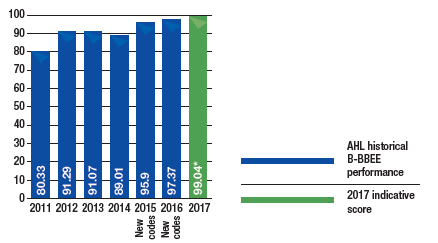
| HISTORICAL B-BBEE PERFORMANCE (POINTS) | |
 |
|
| * Group-projected FY 2017 indicative score. |
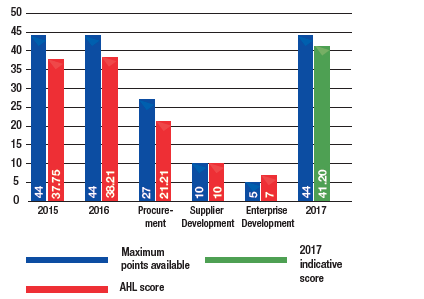
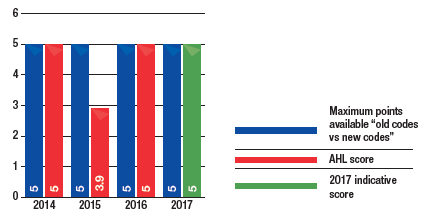
Our sustained improvement on the Broad-Based Black Economic Empowerment scorecard demonstrates our commitment to driving transformation in our Company and in the way in which we do business.
In 2016, AHL commissioned Honeycomb to conduct a B-BBEE verification of the organisation. Honeycomb’s mandate was to assess, verify and validate both disclosed and undisclosed B-BBEE-related information of AHL. The B-BBEE rating was based on the Codes of Good Practice on Black Economic Empowerment released by the dti in October 2013. The Group performs quarterly calculations to project its possible B-BBEE accreditation level ahead of the official verification, which is scheduled for November 2017. The 2017 figures in the accompanying graphs are based on these projections.
AHL is a broad-based entity and was therefore measured on all of the five elements of B-BBEE –Ownership, Management Control, Skills Development, Enterprise and Supplier Development, and Socio-Economic and Sector Specific Contributions.
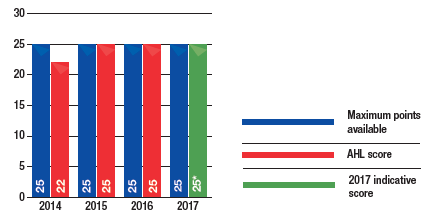
| OWNERSHIP (POINTS) | |
 |
|
| * Group-projected FY 2017 indicative score. |
Honeycomb followed a rigorous verification process that is aligned to best practice verification standards, the dti Codes of Good Practice and the South African National Accreditation System. Honeycomb obtained data and information relating to the elements of the B-BBEE Scorecard, interviewed senior management and personnel of AHL, and verified supporting documents.
All the information used for the verification was obtained from AHL and the conclusions are based on this information. Based on the information provided and subject to the terms of the verification, AHL maintained its level 2 B-BBEE status, whilst improving on the score achieved in FY 2015/2016. The Certificate is valid until December 2017.
OWNERSHIP
AfroCentric Health proprietary limited, is a wholly owned subsidiary of AfroCentric Investment Corporation Limited. The ownership credentials of AfroCentric Investment Corporation Limited are therefore directly attributable to those of AfroCentric Health.
The Ownership profile of AHL (as at July 2017)
| Black exercisable voting rights that flow through to Afrocentric Health Ltd | 34.51% |
|
| Black exercisable voting rights by black women | 13.46% |
|
| Black entitlement to economic interest that flows through to Afrocentric Health Ltd | 34.51% |
|
| Entitlement to economic interest by black women | 13.46% |
|
| Economic interest that flows through to black designated groups | 13.79% |
|
| Involvement of ownership of the Enterprise of black new entrant | 13.57% |
|
The 40% sub-minimum for equity value has been met.
| MANAGEMENT CONTROL (POINTS) | |
 |
|
| * Group-projected FY 2017 indicative score. |
MANAGEMENT CONTROL
- Our Board of Directors has more than 63.64% black representation.
- Voting rights in the hands of black people stands at 63.64%, of which 27.27% are black females.
- The senior management reporting to the Board, comprises 50% black people, with 16.67% being female.
- Black Executive Directors are 57.14%.
- Black women Executive Directors are 28.57%.
A total of 13.41 out of the available 19 points (including the bonus point) were achieved for this element.
EE is driven as part of compliance with the EE Act and this involves compiling a five-year plan, setting quantifiable targets for each race, gender and employment category. Progress is measured and reported annually to the Department of Labour
A universal target is set for compliance with the EE target under the B-BBEE Codes, which is different from the targets the Company has for set itself under the EE Plan. The Company uses these targets to measure its EE performance for the EE element under the BEE Codes.
This element further measures the representation of black disabled in the Company’s total employee population.
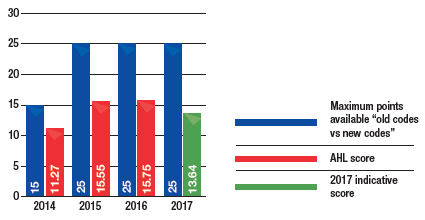
| SKILLS DEVELOPMENT (POINTS) | |
 |
SKILLS DEVELOPMENT
Skills development measures the investment in training and development of black employees as a percentage of the company’s total payroll. This is different to how the training is measured and recorded for the Employment Equity requirements (the latter only measuring the number of people that attended training vs. how much was spent).
We have implemented internship and trainee programmes with accredited INSETA providers, which are designed to comply with the requirements of our sector, and provide accelerated and practical work experience for school leavers, graduates and the unemployed. The Group provides permanent employment to 87 % of all learnerships.
ENTERPRISE AND SUPPLIER DEVELOPMENT
Preferential Procurement
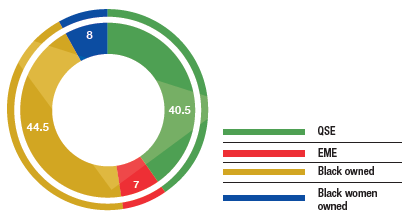
We consider preferential spending on black-empowered companies who provide services and products to our business, with particular focus on black-owned SMMEs, who also have black female and designated group ownership.
| SPEND BY SUPPLIER TYPE (%) | PROCUREMENT SPEND FOR FY 2017 PER B-BBEE LEVEL | |
 |
 |
| ENTERPRISE AND SUPPLIER DEVELOPMENT (POINTS) | |||
 |
|||
|
Enterprise Development
This element is an opportunity to support up and coming SMMEs through loans, or grants or professional services to ensure that they grow and become self-sustaining in the future. The total contributions are measured as a percentage of NPAT. We select beneficiaries in terms of their compliance with the enterprise and supplier development requirements, and give preference to companies operating in the health sector that will help us achieve the outcomes set out for the 10-point plan on health and NHI.
Socioeconomic Development
Contrary to normal corporate social responsibility, SED requirements are very specific. Beneficiaries must be at least 75% black and the initiative must be aimed at including the previously disadvantaged black people in the economy. These include job creation, skills transfer and training, entrepreneurial skills which will enable the individual to either secure employment or to establish their own business.
EMPLOYMENT EQUITY AND EMPLOYEE DEVELOPMENT
EMPLOYMENT EQUITY AND EMPLOYEE PROFILE
AfroCentric believes that a transformation contributes towards a productive, innovative and sustainable business. It is therefore important for us to foster a culture that understands and embraces diversity. As such, Transformation has been and will continue to be a strategic objective for the Group.
During our 2017 financial year, AfroCentric purchased a tool to assist managers to reach their EE targets. The tool allows managers to identify where they are under and over represented in comparison to the economically active population (“EAP”) statistics of South Africa. Our goal is to align our workforce as closely as possible to the EAP, to ensure that we fairly represent all race and gender groups within the business.
Our new tool, the Divisional and National Employment Equity Forums, our EE Policy, the B-BBEE Steering Committee as well as our Transformation strategy contribute towards creating an enabling environment for the successful implementation of Employment Equity within our business.
The table below illustrates the composition of the AfroCentric workforce by race, gender and occupational level.
AFROCENTRIC
Total workforce profile (including employees with disabilities) as at 30 June 2017
| Male | Female | Foreign nationals |
|||||||||||
| Occupational levels | A | C | I | W | A | C | I | W | Male | Female | Total* | ||
| Top management | 1 | – | 2 | 8 | 3 | – | – | 1 | – | – | 15 | ||
|---|---|---|---|---|---|---|---|---|---|---|---|---|---|
| Senior management | 8 | 2 | 5 | 20 | 7 | 1 | 1 | 17 | 1 | – | 62 | ||
| Professionally qualified and experienced specialists and mid-management | 64 | 20 | 32 | 72 | 105 | 45 | 52 | 191 | 1 | 2 | 584 | ||
| Skilled technical and academically qualified workers, junior management, supervisors, foremen, and superintendents | 416 | 245 | 101 | 81 | 1 101 | 724 | 179 | 424 | 2 | 3 | 3 276 | ||
| Semi-skilled and discretionary decision-making | 197 | 6 | 3 | 5 | 236 | 28 | 4 | 24 | – | – | 503 | ||
| Unskilled and defined decision-making | 5 | 2 | – | – | 23 | 8 | 1 | – | – | – | 39 | ||
| Grand total | 691 | 275 | 143 | 186 | 1 475 | 806 | 237 | 657 | 4 | 5 | 4 479 | ||
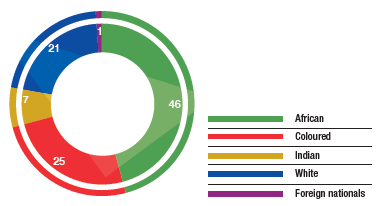
At the end of our financial year, our workforce comprised 2 166 (48%) African employees, 1 081 (24%) coloured employees, 380 (8.5%) Indian employees and 843 (19%) white employees. The Group as a whole has a 71% female and 29% male composition. The Group had a total of 0.1% foreign nationals. As at 30 June 2017, the Group had a total of 40% black representation and a 26% representation at top management.
* The total workforce figure is SA only (excluding outside SA subsidiaries)
Total workforce (including employees with disabilities)
| % OF TOTAL EMPLOYEES – 4 479 | % OF MALE EMPLOYEES – 1 299 | % OF FEMALE EMPLOYEES – 3 180 | ||
 |
 |
 |
Employees with disabilities
One of our main focus areas in creating a diverse workforce is employees with disabilities. Several interventions over the financial year encouraged managers to employ people with disabilities, as well as to better support employees with disabilities already in the business.
Some of these interventions included manager sensitisation sessions which were run across the business for all managers, to better understand disability and its importance in the workplace, and to better support disabled employees.
Employee sessions were run to create a better understanding of what a disability is, how to interact with the disabled as well as how to disclose a disability. It is our intention to run frequent manager and employee sessions to build a culture of openness and trust.
The business further made a commitment to develop people with disabilities by employing four people on a contract to be trained and potentially employed in the future. These employees are being up-skilled in various learning paths, creating a skilled recruitment pool to draw from for potential future vacancies.
This focus has made great strides, and has increased our headcount of employees with disabilities by 28 from the previous financial year. The headcount of our employees with disabilities, as at the end of our financial year, is depicted in the table below.
Profile of employees with disabilities as at 30 June 2017
| Male | Female | Total | |||||||||
| Occupational levels | A | C | I | W | A | C | I | W | |||
| Top management | 0 | 0 | 0 | 0 | 0 | 0 | 0 | 0 | 0 | ||
|---|---|---|---|---|---|---|---|---|---|---|---|
| Senior management | 0 | 0 | 0 | 0 | 0 | 0 | 0 | 1 | 1 | ||
| Professionally qualified and experienced specialists and mid-management | 0 | 1 | 1 | 1 | 0 | 0 | 1 | 4 | 8 | ||
| Skilled technical and academically qualified workers, junior management, supervisors, foremen, and superintendents | 12 | 8 | 1 | 1 | 12 | 13 | 4 | 15 | 66 | ||
| Semi-skilled and discretionary decision-making | 3 | 0 | 1 | 0 | 3 | 0 | 1 | 2 | 10 | ||
| Unskilled and defined decision-making | 0 | 0 | 0 | 0 | 8 | 2 | 0 | 0 | 10 | ||
| Grand total | 15 | 9 | 3 | 2 | 23 | 15 | 6 | 22 | 95* | ||
* The total figure reflected is for SA operations only (excluding outside SA subsidiaries).
TALENT AND LEADERSHIP DEVELOPMENT
AfroCentric employs a number of internal facilitators who provide functional and behavioural courses that equip new and existing employees to perform their jobs. These courses, and courses offered by external providers, are managed and implemented through our Learning and Performance Academy. In addition to short training courses, our Academy runs several curricula that take new employees through several weeks of training to ensure they are fit to perform their jobs once they “hit the ground”.
The Academy also offers several accredited courses, allowing employees to earn credits towards formal qualifications. During the 2016/17 financial year, another round of our NQF 4 and NQF 5 manager qualifications were rolled out by the Academy. These 12-month qualifications involve classroom sessions, workplace exercises, as well as submission of Portfolios of Evidence. The qualifications are intensive learning experiences; however, the skill and knowledge gained by our employees is invaluable.
ONLINE LEARNING
Our Learning and Performance Academy offers online training through our Online Academy. Company policies, legislative courses, behavioural skill courses as well as functional training courses are available to employees on an ongoing basis at any time and in any place. We continue developing our online offering, providing a wide selection of courses to our employees to support them in their current roles and future aspirations.
Study Assistance Programme
Formal studies can be financially taxing. This often results in employees not being able to pursue their study aspirations. We offer a Study Assistance Programme, which sponsors selected employees for their approved studies. The Study Assistance Programme is available to the relevant employees according to the business strategy and priorities. The Group funded 10 employees’ studies over the financial year, and will continue to do so until completion of their qualification.
Over and above this, the Learning and Performance Academy has partnered with Inseta to fund the studies of additional employees. In total, 25 employees received funding for their studies via Inseta over the financial year.
Our contribution towards eradicating the skills shortage
As part of the AfroCentric Group’s contribution towards reducing the skills shortage in the both the private and public health sector, we spent almost a million Rand towards the bursaries of four students studying to become medical doctors.
Each student received R154 272 to cover expenses such as accommodation, tuition and a living allowance. The students also received laptops to assist them in their studies. The criteria applied to select the bursary recipients were based on academic excellence and the financial need of the students.
LEARNERSHIP PROGRAMMES
The Learning and Performance Academy has a number of learnership programmes for both our employees and to unemployed people over the financial year. Our programmes give them the opportunity to gain a qualification as well as valuable working experience. A total of 130 external learners were hosted in the business over the 2016/17 financial year. It is our intention, as a company, to place these learners, wherever possible, within our business after the successful completion of their learnerships.
LEADERSHIP DEVELOPMENT
During the 2016/17 financial year, our leadership competencies were reviewed to ensure alignment with our business strategy. New leadership competencies allow for leadership development programmes where employees are trained to achieve our business goals under a unified leadership brand.
As a business, we understand that being a leader is not so much what you do, but rather how you do it. For this reason, it is important that our leaders are developed and display those behaviours and skills that inspire and engage our employees.
PERFORMANCE MANAGEMENT
AfroCentric uses a Balanced Scorecard (“BSC”) approach to performance management. The BSC provides management with the tools they require to drive future competitive success. It translates an organisation’s strategy into a set of performance measures that provide the framework for a strategic measurement and management system.
When managing individual performance, the aim is to create a “win-win” environment where managers and employees share clear expectations and objectives from the outset. Employees participate in all phases of the process and share ownership of the outcomes with the organisation. Individuals understand how their performance and behaviour links to the organisational strategy. We emphasise self-management in achieving total quality and customer service, and employees are encouraged to maximise their contribution in their current role, while having access to opportunities to grow and develop their careers within the AfroCentric Group.
EMPLOYEE WELLNESS PROGRAMME
AfroCentric’s passion for people, organisational performance and healthcare informs all human capital strategies, policies and structures. The Group employee wellness programme (“EWP”) forms an integral part of the components of the employee value proposition, linking health, wellbeing and overall performance.
The EWP is based on four pillars: physical wellbeing, emotional wellbeing, financial wellbeing and organisational wellbeing. It provides independent, confidential, professional counselling and advisory services to permanent and non-permanent employees and their direct household dependants.