



REMUNERATION COMMITTEE REPORT
INTRODUCTION
Fair and responsible remuneration practices in the Group are a shared responsibility between management, the Board and shareholders as depicted below. The roles and responsibilities of the various stakeholders have been defined and encapsulated in, for example, the terms of reference of the Group Remuneration Committee.

This Remuneration Committee Report primarily deals with the remuneration of the Group’s Executive Directors, Non-executive Directors and other executives, whilst high level reference is made in relation to other employees.
REMUNERATION PHILOSOPHY, STRATEGY AND POLICY
The Group’s remuneration philosophy is reviewed annually to ensure alignment with developments in remuneration practice and applicable legislation. It was revised after a number of key considerations, including:
- the requirements as contained in the King IV Report on Corporate Governance for South Africa 2016;
- consultations with specialist advisors in this field regarding best practice;
- feedback from various stakeholders including shareholders;
- the need for strategic alignment across the Group;
- market research;
- various socioeconomic drivers;
- greater need for compliance with regards to remuneration practices; and
- Group Strategy
Our Remuneration Policy provides a framework for managing total remuneration within the Group, and also supports the Group’s employee value proposition. The policy is Board approved.
To ensure that we protect value we use the following guiding principles with regard to AfroCentric’s remuneration philosophy, which is centred on the following key considerations:
- Resolute commitment to best practice in areas of remuneration and reward, underpinned by statute, regulations and related guidelines
- Attracting, rewarding, motivating and retaining exceptional people with the right mix of experience, skills and knowledge who deliver against strategic imperatives and achieve sustainable growth
- Ensuring that sustainable high levels of performance and value creation standards are aligned to the objectives of shareholders, where senior management share an appropriate level of personal risk
- To support and reinforce our desired culture and encourage behaviour consistent with our values, thereby stimulating employee engagement
- To drive a high-performance culture and incentivise employees for excellent execution of our strategic priorities
- To enable appropriate transparency in the development of remuneration programmes and the allocation of individual remuneration to ensure equity and fairness based on valid and appropriate external and internal benchmarks
- To align with the principles of good corporate and remuneration governance, ensuring an appropriate share of value for the relevant stakeholders in our business
- Regular evaluations, peer-group reviews and related surveys to ensure comparative and contextual pay-for-performance
SCOPE OF THE POLICY
The remuneration policy applies to all entities in the Group, including wholly owned subsidiaries and those in which we have a majority interest, but excludes companies where we have a minority share. The policy applies uniformly in all such jurisdictions, except where it is in conflict with either local statutes or regulations, in which case such statutes and regulations will apply.
AfroCentric Health’s remuneration strategy is positioned to attract, retain and motivate outstanding talent and thereby achieve business sustainability and the key strategic objectives of the Group.
The remuneration strategy is underpinned by the following two inter-dependent dimensions:
- Guaranteed remuneration is a Total Guaranteed Package
(“TGP”), which holistically comprises salary (“base pay”),
medical aid, pension, allowances, and the like. The TGP is the minimum remuneration receivable by an executive or
employee in the absence of any other incentives.
Annual benchmarking assesses the appropriateness of TGP against comparable firms and industries. The combination of distribution of guaranteed remuneration within the earnings ranges and the market relativity of our guaranteed remuneration is a primary input into the annual salary review process, but in all instances subject to affordability and appropriate consideration of the sustainability of our remuneration practices.
Whilst it is the Group’s policy to benchmark remuneration at the market median, certain roles are remunerated in excess of the median – the health and information technology industries require highly specialised skills, and the current remuneration mix does not allow for long-term incentive (“LTI”) schemes, or above-average STI schemes in comparison to market. The Group Remuneration Committee, in consultation with the Board and stakeholders, agreed to review and appropriately revise the guaranteed and variable remuneration elements, including but not limited to, STIs and LTIs, in the next financial year.
Robust job profiling aids remuneration benchmarking. This enables consistency in the sizing of roles, and the associated benchmarking of guaranteed remuneration levels.
Furthermore, individual performance determines the extent of an individual’s progression within an earnings range. Thus, performance and individual market position are used concurrently when remuneration increases are determined.
Guaranteed remuneration is only adjusted outside the annual review process in exceptional circumstances, such as changes in responsibility or with the intention of retaining specific talent. These are subject to appropriate approval based on the relevant delegations of authority.
- A Management Short-term incentive is focused on the
executive team as well as tier two managers, being those
that report directly to the executive, as well as employees
selected based on value contribution and scarce and critical
skill criteria.
The scheme is targeted at between 15% and 60% of TGP depending on the executive and employee’s level within the organisation, subject to the achievement of pre-determined performance thresholds – the first condition being the achievement of Group EBIT as determined by the Board. Individual performance below threshold will result in zero STI awarded (the STI metrics and ranges are described below), where exceptional individual performance will accelerate the employee’s bonus.
An alternative STI or management performance bonus, targeted at 100% of monthly TGP, was introduced at the request of the Group Remuneration Committee (see details below). Exceptional individual performance will be rewarded with additional bonus payments as provided for in the rules of the bonus scheme, approved by the Group Remuneration Committee and adopted by the Board.
REMUNERATION GOVERNANCE
We comply with all relevant remuneration governance codes that apply in our various operating jurisdictions. In South Africa, we comply with the King III provisions.
Our Group Remuneration Committee is mandated by the Board to oversee and govern all aspects of remuneration and associated employee benefits, and all outcomes are reported to the Board.
In addition, the Committee also conducts an annual self-assessment of its effectiveness and has independent, specialist advisors who provide strategic input on remuneration best practices and benchmarking on the various elements within the remuneration mix.
PERFORMANCE MANAGEMENT
The aim of our performance management process is to ensure alignment between the various business units, our client needs and the Group’s strategy.
The core principles of our performance management process are:
- Performance management is a process of ongoing dialogue and continuous feedback between stakeholders throughout the period to ensure cooperation and consensus.
- Performance objectives include both financial (where appropriate) and non-financial indicators.
- Performance management is a primary input into remuneration management with the aim of ensuring adequate differentiation based on individual contribution.
GROUP REMUNERATION COMMITTEE
The Group Remuneration Committee (“the Remuneration Committee”) is a Sub-committee of the Board and oversees the approach to and governance of remuneration matters. It also determines the remuneration of Executive Directors, other executives as well as the remuneration of Non-executive Directors, which is ultimately approved by shareholders.
The Remuneration Committee consists of five members, including an Independent Chairperson. The majority of members are Independent Non-executive Directors. The Human Capital Executive is a permanent invitee to the Committee, who, along with the Group CEO, Mr Antoine van Buuren and Mr Willem Britz are recused from meetings where Executive remuneration (guaranteed or variable) is discussed.
| Name | Role/classification | Number of meetings held/attended |
|
| MJ Madungandaba | Non-executive Director and Chairperson of Remuneration Committee1 | 4/4 | |
| MI Sacks | Independent Non-executive Director | 2/4 | |
| JM Kahn | Lead Independent Non-executive Director | 4/4 | |
| A Banderker | Non-executive Director | 3/42 | |
| R Wa-Mundalamo | Independent member | 1/23 |
| 1 | Mr Joe Madungandaba was the Remuneration Committee Chairperson for ACT and with the consolidation of ACT and AHL on the 9th of
September 2016, the Remuneration Committees were also amalgamated, and Mr Madungandaba remained on as Chairperson of the Remuneration Committee. |
| 2 | Mr Ahmed Banderker was only appointed to the Remuneration Committee effective November 2016. |
| 3 | Mr Ronald Wa-Mundalamo, previously the Remuneration Committee Chairperson for AHL, was appointed as a member to the Remuneration Committee effective November 2016. |
REMUNERATION COMMITTEE FEES
Committee fees are reviewed annually by the Board taking into account market surveys of similar sized firms as well as recommendations made by the Group Remuneration Committee. A 4.7% fee increase for the Chairperson and Non-executive Directors (“members”) for the 2016/2017 period was approved. Fees are paid on a per-meeting basis.
| Committee member fees | Fee per meeting | |
| Chairperson | R19 155 | |
| Member | R14 047 |
Prior to November 2016 and the consolidation of the AHL (AfroCentric Health Proprietary Limited) and ACT (AfroCentric Investment Corporation Limited) Boards, Committee members, in particular Mr Joe Madungandaba and Mr Ahmed Banderker were retained by means of a quarterly retainer and as such did not receive additional fees in respect of meeting attendance.
Mr Meyer Kahn and Mr Michael Sacks opted to waive committee fees.
There were no material issues identified in the Committee’s self-assessment in 2017, which was undertaken to evaluate its effectiveness against the objectives of its charter.
The Group Remuneration Committee is governed by a terms of reference with a synopsis set out below:
- Assist the Board in developing the Group’s general policy on remuneration for executive and senior management, taking into account Group strategy and individual performance whilst encouraging enhanced performance in a fair and responsible manner, and rewarding them for their individual contributions to the success of the Company. Such a policy is presented to the shareholders to pass a non-binding advisory vote on.
- Review the ongoing appropriateness and relevance of the Group’s remuneration policy.
- Administer such policy, by determining specific remuneration packages for Executive Directors, the Company Secretary and other senior executives of the Company, including but not limited to basic salary, benefits in kind, any annual bonuses, performance-based incentives, share incentive, pensions and other benefits.
- Approve the design of, and determine targets for, any performance related pay schemes operated by the Company and approve the total annual payments made under such schemes.
- Review the design of all share incentive plans for approval by the Board and shareholders.
- Determine the policy for, and scope of, retirement arrangements for each Executive Director and other Senior Executives.
- Ensure that contractual terms on termination, and any payments made, are fair to the individual and to the Company, that failure is not rewarded and that the duty to mitigate loss is fully recognised.
- Review and note annually the remuneration trends across the AfroCentric Group.
- Oversee any major changes in employee benefits structures throughout the AfroCentric Group.
- Agree the policy for authorising the claims for expenses from the Group Chief Executive Officer and the Chairperson.
- Ensure that all provisions regarding disclosure of remuneration, including pensions, are fulfilled.
- Be exclusively responsible for establishing the selection criteria, selecting, appointing and setting the terms of reference for any remuneration consultants who advise the Committee.
- Obtain reliable, current information about remuneration in other similar size or industry-related companies. The Committee shall have full authority to commission any reports or surveys which it deems necessary to help fulfil its obligations.
- Advise the Board on any retrenchment programme affecting the entire Group, as may become necessary from time to time.
The Remuneration Committee applies the guiding principles enunciated in the Remuneration policies and scheme rules, but retains the right to apply discretion to deviate from these in exceptional circumstances.
During 2016, the Remuneration Committee was required to apply discretion in respect of the management short-term incentive pay-out as the gatekeeper target (EBIT) was not achieved. The incentive scheme rules allow, in such instances, a penalty, left up to the discretion of the Remuneration Committee, on condition that the threshold target is achieved.
The Committee, taking into account some exceptional items, declared an incentive pay-out calculated at 75% of the allowable bonus incentive pool. The incentive pool was distributed to participants according to the rules, role and performance contribution.
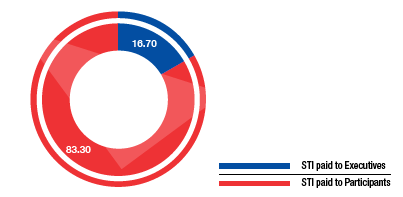
In respect of the 2016 financial year, the Remuneration Committee approved a total STI pool of R60.568 million for distribution (2015: R71.86 million). Executive STIs represented 16.70% of the total STIs paid to participants during the reporting period. Participants had to be in the employ of the Company at the time of the STI payment.
| 2016 STI distribution (%) |
 |
KEY REMUNERATION DECISIONS TAKEN DURING THE PERIOD OF REVIEW
In line with the Group’s strategic direction and its responsibility to employ fair and sustainable remuneration practices, the Remuneration Committee took a number of key decisions during the reporting period:
- Review of the remuneration policy to ensure alignment to the Group’s strategic imperatives
- Review of the short-term incentive scheme
- Approval for the development and implementation of an LTI scheme
- Review and approval of executive remuneration increases
- Evaluated executive performance as input into the determination of executive short-term incentives
- Review and recommendation of Board Fees for the reporting period
- Executive performance scorecard was reviewed to ensure that the interests of Directors were aligned to the interests of shareholders and creating value, with focus on drivers such as financial growth, risk management and strategic impact
- Review of the remuneration and reward structures to include LTIs, with the view to attract, engage, motivate and retain key employees
- Review of remuneration in respect of Non-executive Director’s fees
- Appointments of Executive Directors – remuneration as well as terms and conditions of employment
REMUNERATION ELEMENTS
GUARANTEED REMUNERATION INCREASES
At 30 June 2017, a total of approximately 1 514 of our employees were covered under collective bargaining agreements with NEHAWU: In June 2016, 6.8% of the guaranteed remuneration for employees in the bargaining unit was made available for annual increases, compared with 6.5% and 6.45% for the non-bargaining unit and executives respectively. This resulted in an overall increase in the Group’s salary bill of 7.08% (excluding executives).
Accordingly, we continue remunerating our employees in the bargaining unit appropriately relative to the industry and continue to seek measures to reduce any pay differentials.
VARIABLE REMUNERATION
Short-term incentive (STI)
STIs are delivered through our discretionary STI arrangements. The aim of STIs is to drive sustainable results within an agreed risk appetite framework and to encourage behaviours that are consistent with our values and aligned with the best interests of our stakeholders.
As a general rule, all STI plans are funded from our overall STI pool, subject to sustainability and affordability. With these principles in mind, the STI scheme introduced in 2015 was reviewed at the behest of the Remuneration Committee and the Board. The revised schemes saw a review of participation and award linked to the amount of risk taken by the role and a bonus was introduced in respect of employees where risk taking is limited. STI payments, typically made in cash, are subject to achievement of individual performance and minimum Group performance standards in respect of EBIT (“Earnings Before Interest and Tax”) as well as non-financial indicators set by the Remuneration Committee.
STI participation is discretionary and therefore there is no right to a performance incentive award in any given year. At an individual level, STIs are determined primarily on the basis of performance, employees performing below a minimum acceptable level are not eligible for consideration for an STI award. This principle is central to all variants of STI schemes.
STI metrics and performance ranges will be set each year by the Remuneration Committee of the Board for application in the coming financial year.
A combination of financial and non-financial metrics is used to determine incentive amounts to reduce the risk of unintended outcomes. The following key drivers will apply to the short-term incentive scheme for executives:
- Financial (Earnings Before Interest and Tax (“EBIT”))
- Risk management as measured by the Audit and Risk Committee
- Strategic impact
- Business unit specific objectives
Note that performance below threshold on any metric results in a zero score for that proportion. Non-executive Directors are not allowed to participate in any incentive scheme.
LONG-TERM INCENTIVES
The original long-term share-based scheme, created as part of the warranty conditions set out in the Sale of Share Agreement between the vendor consortium and AfroCentric during 2013, has run its course. No further shares have been issued under this particular scheme and all vesting conditions have been met.
However, in terms of the rules of the scheme and for selective executives employed at the time of the introduction of the AfroCentric Share Warranty scheme, the available pool of forfeited shares would be distributed on a percentage of remaining shares held by participants. The total number of shares available amounted to 1 518 605 shares which were allotted to Mr Kevin Aron, Mr Tim Rametse, Mr Lee Callakoppen and Mr Vijay Pillay.
NEW LONG-TERM INCENTIVES
Further to comparative peer group reviews, benchmarking and best practice, our shareholders approved the implementation of an employee share scheme and the Group’s remuneration strategy will be further revised in consultation with shareholders to make provision for an LTI scheme which will be launched during the 2018 financial year.
The LTI is aimed at retaining, motivating and rewarding those executives and senior managers who influence the long-term sustainability, value creation and strategic objectives of the Group on a basis which aligns their interests with those of the Group’s shareholders. The objective is to share ownership of the Group’s wealth with executives and selected employees that contribute to the growth and wealth generated by the Company and, hence, place a value instrument in the hands of employees.
The scheme will be governed by the rules of the AfroCentric Management Long Term Incentive Plan 2018.
EXECUTIVE AND NON-EXECUTIVE DIRECTORS’ REMUNERATION
INCREASE IN GUARANTEED PAY
The annual revised guaranteed pay for the Group CEO and other Executive Directors was recommended to the Board by the Remuneration Committee for final approval. Such recommendations took into account individual performance as well as benchmarking of similar sized firms to ensure that guaranteed pay is suitably positioned.
Adjustments as set out below were approved for implementation 1 August 2016, with the exception of Mr Hannes Boonzaaier, whose annual adjustment was effective 1 July 2016.
| Guaranteed package (“GP”) (R) |
Increase (%) |
|||
| Name | 2016 | 2015 | 2016 | |
| A van Buuren | 3 727 5004 | 3 500 000 | 6.5 | |
| WH Britz | 3 727 5005 | 3 500 000 | 6.5 | |
| H Boonzaaier | 2 848 4886 | 2 513 808 | 13.3 | |
| 4 | Effective 1 August 2016 only. |
| 5 | Effective 1 August 2016 only. |
| 6 | Following market benchmark review of CFO remuneration in similar industries and market caps, a further adjustment of 6% was made effective 1 November 2016. |
NON-EXECUTIVE DIRECTOR INCREASES
The Non-executive Director Remuneration fee proposal was approved by the shareholders at the Annual General Meeting. Increases to the Chairperson’s fees and Committee fees ranged between 5.3% and 4.7%. The fee structure set out below is for the period 1 January 2017 to 31 December 2017 and is applicable to AfroCentric. The period is aligned to the Annual General Meeting where these fees are presented to the shareholders for approval and not necessarily aligned to the Group’s financial year.
| Approved 2017 (R) |
Current 2016 (R) |
Increase (%) |
|||
| Main Board (retainer fee paid quarterly) | |||||
| Chairperson | 228 500 | 217 000 | 5.3 | ||
| Member | 209 400 | 200 000 | 4.7 | ||
| Subsidiary Board (per meeting fee basis) | |||||
| Chairperson | 19 200 | 18 295 | 4.7 | ||
| Member | 14 000 | 13 416 | |||
| Audit and Risk Committee (per meeting fee basis) | |||||
| Chairperson | 25 500 | 24 393 | 4.7 | ||
| Member | 18 600 | 17 740 | 4.7 | ||
| Remuneration Committee (per meeting fee basis) | |||||
| Chairperson | 19 200 | 18 295 | 4.7 | ||
| Member | 14 000 | 13 416 | 4.7 | ||
| Nomination Committee (per meeting fee basis) | |||||
| Chairperson | 19 200 | 18 295 | 4.7 | ||
| Member | 14 000 | 13 416 | 4.7 | ||
| Social and Ethics Committee (per meeting fee basis) | |||||
| Chairperson | 19 200 | 18 295 | 4.7 | ||
| Member | 14 000 | 13 416 | 4.7 | ||
| Investment Committee (per meeting fee basis) | |||||
| Chairperson | 19 200 | 18 295 | 4.7 | ||
| Member | 14 000 | 13 416 | 4.7 | ||
In respect of AHL, a retainer based fee, which is payable monthly is set out below.
| AHL Fees | Approved 2017 (R) |
Current 2016 (R) |
Increase (%) |
||
| Chairperson | 649 857 | 649 857 | – | ||
|---|---|---|---|---|---|
| Member | 414 675 | 414 675 | – | ||
PAYMENTS MADE TO EXECUTIVE DIRECTORS
| Name | Base pay (normal earnings) (R) |
Benefit (M/A + Group Life) (R) |
Retirement fund (R) |
STI (R) |
Total (current year) (R) |
Total (previous year) (R) |
|||
| WH Britz | 3 376 407 | 140 143 | 191 991 | 1 533 000 | 5 241 541 | 3 208 828 | |||
|---|---|---|---|---|---|---|---|---|---|
| A van Buuren | 3 488 792 | 27 758 | 191 991 | 1 533 000 | 5 241 541 | 3 208 828 | |||
| H Boonzaaier | 2 593 947 | 65 593 | 135 204 | 1 043 544 | 3 838 290 | 3 408 824 | |||
PAYMENTS TO NON-EXECUTIVE DIRECTORS
In addition to payments received at Group level, Dr Anna Mokgokong, Mr Joe Madungandaba and Mr Ahmed Banderker also received payments at an AHL operational level. The split in fees for Dr Anna Mokgokong are R228 500 and R649 857 for services rendered at the Group and AHL levels respectively. The rationalisation of the two companies is now completed. Work performed at these subsidiary levels is continuing; hence, a fully inclusive fee is being proposed for the 2018 AGM for services rendered at the listed entity and operational entities. It must be noted that AHL fees were not increased from the previous year and were accepted by and agreed to the Board on the 10th of March 2017.
Mr Michael Sacks and Mr Meyer Kahn waived all fees.
Fees paid in respect of ACT Board
| Name | Status of Director |
Board fee/ Directors fee (R) |
Audit and Risk Committee fees (R) |
Remuneration Committee fees (R) |
Other Meeting fees (R) |
Total current year 2016 – 2017 (R) |
Total previous year 2015 – 2016 (R) |
|||
| ATM Mokgokong | Active | 222 750 | 38 310 | 261 060 | 833 078 | |||||
|---|---|---|---|---|---|---|---|---|---|---|
| MJ Madungandaba | Active | 204 700 | 38 310 | 80 451 | 323 461 | 861 128 | ||||
| A Banderker | Active | 204 700 | 14 047 | 42 141 | 260 888 | |||||
| IM Kirk | Active | 204 700 | 204 700 | |||||||
| SE Mmakau | Active | 104 700 | 55 722 | 14 047 | 174 469 | |||||
| ND Munisi | Active | 204 700 | 19 155 | 223 855 | 100 000 | |||||
| LL Dhlamini | Active | 204 700 | 76 617 | 281 317 | 100 000 | |||||
| HG Motau | Active | 34 900 | 34 900 | |||||||
| NB Bam | Resigned | 66 666 | 66 666 | 195 400 | ||||||
| Y Masithela | Resigned | 50 000 | 50 000 | 195 400 | ||||||
| JG Appelgryn | Resigned | 66 666 | 66 666 | 195 400 | ||||||
| GL Napier | Resigned | 66 666 | 66 666 | 195 400 | ||||||
| NV Qangule | Resigned | 204 700 | 55 722 | 260 422 | 615 108 | |||||
| Grand total | 1 840 548 | 188 061 | 52 357 | 194 104 | 2 275 070 | 4 824 512 | ||||
Fees paid in respect of the AHL Board
| Name | Status of Director |
Board fee/ Directors’ fee (R) |
Audit and Risk Committee fees (R) |
Remuneration Committee fees (R) |
Other Committee fees (R) |
Total current year 2016 – 2017 (R) |
||
| ATM Mokgokong | Active | 649 858 | 649 858 | |||||
|---|---|---|---|---|---|---|---|---|
| MJ Madungandaba | Active | 414 676 | 17 740 | 26 832 | 45 127 | 504 375 | ||
| A Banderker | Active | 414 676 | 26 832 | 441 508 | ||||
| Grand total | 1 479 210 | 17 740 | 26 832 | 71 959 | 1 595 741 | |||