
OVERVIEW OF REMUNERATION POLICY
Overview of remuneration policy
Employees are at the core of our business as we require highly skilled, competent and experienced employees to drive our business growth. Therefore, we need to reward them for their performance and contribution towards wealth maximisation for our shareholders.
While we apply a common remuneration structure across the Group, we differentiate its implementation according to the size of various companies within the Group.
Key principles, consistent with the previous financial year, that govern Group-wide remuneration at all levels are:
- Pay for performance methodology, linking executive reward to business performance. This allows for differentiated increases based on the individual's contribution and performance
- Ensure (i) that external parity is maintained, (ii) market relevance, and (iii) internal equitability is balanced and that pay adjustments are affordable to the organisation
- Ensure a remuneration mix that will attract the best talent in the market and retain top talent in the organisation
- Align executives to shareholder interest by linking STI and LTI to performance indicators not limited to financial indicators
Pay for performance
Executives' remuneration is based on level of accountability, complexity and nature of the role which is sized relative to the organisation's turnover, number of employees (including wage bill), market cap, assets and net after tax profitability benchmarked to the external market.
The below table shows the relationship between the Group's strategy, its pay for performance philosophy and requirements set out in the King IV:
| Strategic objective: Maximise shareholder value and return sustainably |
| Strategic aspiration: 15% return on investment year on year |
| Annual target: R554 million EBIT |
Strategic goals
| Enhance shareholder value | Achieve objectives | |
| Maximise growth opportunities | ||
| Diversity revenue sources | ||
| Transformation and skills development | Spend resources wisely | |
| Reduced cost of healthcare | Do it sustainably |
Our deliverables, contained in our Balanced Scorecards (BSCs), are derived from and directly support the Group strategy. The Group BSC cascades to the various business units and the individual performance scorecards. Each BSC’s items support the BSC above it, ultimately supporting the Group strategy.
Remuneration structure and relation to remuneration policy
The key components of our remuneration policy, structure and incentive targets are set out in the table below.
Guaranteed pay |
Variable pay |
|||||||||||||
| Remuneration element | Base pay | Benefits and allowances | Short-Term Incentive (STI) | Long-Term Incentive (LTI) Plan | ||||||||||
| Monthly salary |
|
|
Vesting share scheme | |||||||||||
| 1 Employees elect participation in either a pension fund or the NEHAWU Provident Fund, the latter being available to NEHAWU members only. | ||||||||||||||
Policy principles |
|
|
|
|
||||||||||
Policy application |
|
|
|
|
||||||||||
Objective of the element |
Attraction and retention |
|
|
|
||||||||||
Eligibility |
All employees |
|
|
|||||||||||
|
||||||||||||||
Pay level is set through |
Market benchmarking according to job family grouping, job grade and individual long-term performance. |
|
|
|||||||||||
Number of participants |
402 | 54 | ||||||||||||
Guaranteed pay
AfroCentric's policy is to reward its employees fairly and consistently according to their role and their individual contribution to the Group and its performance.
STIs
The strategic management incentive scheme is focused on the executive team as well as tier two managers, being those that report directly to the executive as well as employees selected for value contribution and scarce and critical skills.
Strategic management STI
STI |
= |
GP |
X |
On-target % |
X |
Business multiplier |
X |
Personal performance multiplier |
||||||||
| Based on below threshold – 0%, on-target – 100%, stretch – 150% | Performance rating | Range | ||||||||||||||
| Level | Measure 1 | Measure 2 | Measure 3 | 5 | 150% | |||||||||||
| Group CEO | 60% | 4 | 125% | |||||||||||||
| Executive irector | 60% | EBIT (40%) | Risk (10%) | Strategic impact (50%) | 3 | 100% | ||||||||||
| Group CFO | 45% | 2 | 50% | |||||||||||||
| Executive Committee | 40 to 50% | 1 | 0% | |||||||||||||
STI pool distribution
|
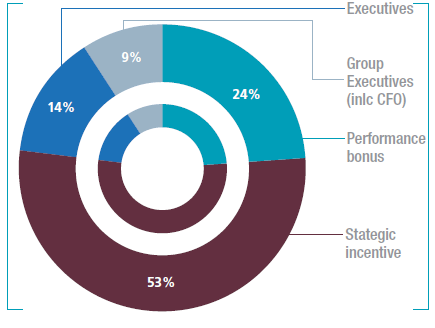
Earning potential between on-target and stretch performance is interpolated on a linear basis. Also, using the eligibility percentages, organisational and personal performance regulate actual bonus outcomes for the Group. The Group CEO’s, CFO’s and executives’ performance are 100% based on the Group performance and relates to the ‘business multiplier’ component shown above.
Performance below threshold results in a zero score, and the individual will not be eligible for consideration for an STI award. This principle is central to all variants of incentive schemes.
During the 2017 financial year, an alternative STI or management performance bonus targeted at 100% of guaranteed monthly package was introduced at the request of the Remuneration Committee. Exceptional performance was rewarded with additional bonus payments as provided for in the rules. Due to the close relationship to financial targets, payment of any incentives in terms of the strategic management incentive scheme is done on the back of the audited financial results.
Unlike in the 2017 financial year, the gate-keeper target (EBIT) was met in the 2018 financial year, and the Committee approved STI payments at a 100% of the allowable bonus pool. The below graph shows the distribution of payments in respect of the various incentive schemes.
A total STI pool approved for distribution by the Committee in respect of the 2018 financial year was R79 157 million (2017: R60 568 million1).
All payments in relation to the strategic management incentive scheme, as well as the performance bonus scheme, were approved by the Committee. In addition, the Remuneration Committee approved the Group’s performance areas for the 2018 financial year as well as long-term objectives over a three to five-year period, thus ensuring long-term business sustainability.
1 Represents the 75% bonus as result of a penalty applied by the Remuneration Committee.
LTI Plan
2018 saw the LTI Plan approved by the Board and shareholders at the Annual General Meeting held on 8 November 2017 with a majority vote.
The LTI Plan is aimed at retaining, motivating and rewarding executives and senior management who influence the long-term sustainability, value creation and strategic objectives of the Group on a basis which aligns their interests with those of the Group’s shareholders. It also, provides necessary market related remuneration, particularly at executive level.
The mechanism of the LTI Plan is shown below:
| Share appreciation rights | ||
| Award mechanism | Linked to job grade and allocated by the Committee. The Committee has discretion within a range per job grade with a maximum number of shares set per grade. | |
| Bonus shares | Discretionary allocation by Committee taking into account scarce skills, personal performance ratings, leadership and potential. | |
| Vesting | Five-year vesting based on anniversary of allocation:
Year 3 – 1/3, year 4 – 1/3 and year 5 – 1/3. |
|
| Participation | Individual participation is reviewed annually by the Committee to ensure alignment to the strategic objectives of the Group and consideration is given to:
|
|
| Eligibility | Executives, general managers, senior managers and specialists | |
| Conditions | Share award is conditional to the retention period provided employee is eligible |
The first award has been made in terms of the registered rules and a total of 4 440 000 shares were awarded to participants. The allocations for all participants were approved by the Remuneration Committee. The Group CEO and Executive Directors do not participate in the LTI Plan.
Service contracts and notice periods
AfroCentric can terminate executive employment summarily for any reason recognised by law in the respective jurisdiction.
It is the policy that the Executive Directors and executives have employment agreements with the Group which may be terminated with notice periods of three months. Executive Directors may be required to work during the notice period but, if not, the full notice period may be provided with pay in lieu of notice (subject to mitigation where relevant).
STIs on termination of employment
There is no automatic entitlement to annual STIs on termination, but it may be considered at the Committee's discretion taking into account performance measures during the period. Any such payment will be pro-rated to service. The governing rules require active employment on the date of payment.
No bonus will be payable in the case of misconduct or resignation, unless done under extenuating circumstances.
Unvested share awards
Outstanding unvested bonus awards would lapse if the Executive Director or prescribed officer leaves by reason of resignation or termination for gross misconduct. However, in the case of death, the Executive Director (through his/her estate) will continue to be eligible to be considered for unvested portions or deferred awards, subject to the rules of the plan. In instances of termination on the basis of injury, disability, ill-health, retirement or redundancy, unvested shares will be managed in accordance with the rules of the plan.
Any unvested shares in the case of misconduct will lapse with immediate effect.
Implementation of the remuneration report and remuneration policy
The implementation report details the principles implemented in 2018.
Fixed remuneration increases
Recognising the need to remunerate executive management fairly and responsibly in the context of overall remuneration, we award higher increases to bargaining unit employees than to executive levels as shown. Increases in respect of the bargaining unit are negotiated annually with NEHAWU, the recognised labour union, taking into account a variety of internal and external factors such as affordability, market conditions, benchmark information, to name but a few.
The remuneration policy and implementation report set out above are proposed to shareholders in separate non-binding advisory notes in terms of the notice of annual general meeting. In the event that either the remuneration policy or the implementation report, or both, are voted against by 25% or more of the votes excised at the annual general meeting, the Board of Directors will engage with such shareholders in order to clarify the nature of and evaluate the validity of such objections and will, where possible and prudent, given the objectives of the remuneration policy, take objections into consideration when formulating any amendments to the company’s remuneration policy and implementation report in the following financial year.
Remuneration increase (%)
|

Executive and Non-executive Directors' remuneration
Non-executive Directors
The table below sets out the remuneration principles applied by the Group for the 2018 financial year for Non-executive Directors. These policies also apply for the 2019 financial year and form the underlying basis for the fees tabled for approval at the AGM held on 8 November 2017.
| Chairman | Deputy Chairman | Directors and Lead Directors | Committee | |||||
| Objective | A market-related fee to attract and retain experienced and diverse Non-executive Directors. | Fees to reflect the additional responsibilities undertaken through membership of committees. Committee chairmen receive an additional amount. | ||||||
Fee principles |
Fees are reviewed annually, and fees in respect of the Chairman and Deputy Chairman were adjusted during the reporting period following the benchmark done by PwC. Fees reflect the time commitments in respect of meetings but also additional stakeholder relations as well as other standard duties associated with each role. Fees are fully inclusive. The Remuneration Committee recommends the fees to the Board for final approval. |
|||||||
Payable |
Main Board – quarterly
Subsidiary Board – monthly |
Per meeting fee payable monthly | ||||||
The below table sets out the fees for the period 1 January 2018 to 31 December 2018 approved by means of majority vote during the Annual General Meeting.
| Approved 2018 (R) |
Current 2017 (R) |
Increase (%) |
||||
| Main Board (annualised retainer fee) | ||||||
| Chairman | 1 200 000 | 833 000 | Benchmarked | |||
| Deputy Chairman | 900 700 | 861 000 | Benchmarked | |||
| Member | 223 000 | 209 400 | 6.5 | |||
| Subsidiary Board (per meeting) | ||||||
| Chairman | 20 400 | 19 155 | 6.5 | |||
| Member | 15 000 | 14 047 | 6.5 | |||
| Audit and Risk Committee (per meeting) | ||||||
| Chairperson | 27 200 | 25 539 | 6.5 | |||
| Member | 20 000 | 18 574 | 6.5 | |||
| Remuneration Committee (per meeting) | ||||||
| Chairperson | 20 400 | 19 155 | 6.5 | |||
| Member | 15 000 | 14 047 | 6.5 | |||
| Nomination Committee (per meeting) | ||||||
| Chairperson | 20 400 | 19 155 | 6.5 | |||
| Member | 15 000 | 14 047 | 6.5 | |||
| Social and Ethics Committee (per meeting) | ||||||
| Chairperson | 20 400 | 19 155 | 6.5 | |||
| Member | 15 000 | 14 047 | 6.5 | |||
| Investment Committee (per meeting) | ||||||
| Chairperson | 20 400 | 19 155 | 6.5 | |||
| Member | 15 000 | 14 047 | 6.5 | |||
| ICT Steering Committee (per meeting) | ||||||
| Member | 15 000 | 14 047 | 6.5 |
Payments made to Non-executive Directors
The below fees were paid in respect of the ACT Board
| Name of Director | Board fees (R) |
Audit Committee (R) |
Remun- eration Committee (R) |
SEC (R) |
ICT Steerco (R) |
Nominations (R) |
Investment Committee (R) |
Total current year 2017 – 2018 (R) |
Total previous year 2016 – 2017 (R) |
|||
| AT Mokgokong | 714 250 | – | – | – | – | 20 400 | – | 734 650 | 261 060 | |||
|---|---|---|---|---|---|---|---|---|---|---|---|---|
| MJ Madungandaba | 693 919 | – | 61 200 | – | – | – | 61 200 | 816 319 | 323 461 | |||
| A Banderker | 216 200 | – | 58 094 | – | – | 15 000 | 87 141 | 376 435 | 260 888 | |||
| I Kirk | 216 200 | – | – | – | – | – | – | 216 200 | 204 700 | |||
| SE Mmakau | 216 200 | 154 296 | – | – | 63 202 | – | – | 433 698 | 174 469 | |||
| ND Munisi | 216 200 | – | – | 59 955 | – | – | 15 000 | 291 155 | 223 855 | |||
| LL Dhlamini | 216 200 | 210 956 | – | – | – | – | – | 427 156 | 281 317 | |||
| GH Motau | 200 998 | 97 148 | – | – | – | – | – | 298 146 | 34 900 | |||
| R Mundalamo | – | – | 59 047 | – | – | – | – | 59 047 | – | |||
| Total | 2 690 167 | 462 400 | 178 341 | 59 955 | 63 202 | 35 400 | 163 341 | 3 652 806 | 1 764 650 |
Mr Michael (Motty) Sacks and Meyer Kahn waived all fees.
Fees paid in respect of AHL Board
The AHL Board was incorporate into the ACT Board effective 1 January 2018 and hence fees received are for the period 1 July 2017 to 31 December 2017.
| Name of Director | Status | Board fees (R) |
Audit and Risk Committee (R) |
Remuneration Committee (R) |
Other committees (R) |
Total current year 2017 – 2018 (R) |
Total previous year 2016 – 2017 (R) |
|||
| AT Mokgokong | Active | 324 929 | 324 929 | 649 858 | ||||||
|---|---|---|---|---|---|---|---|---|---|---|
| MJ Madungandaba | Active | 207 338 | 207 338 | 504 375 | ||||||
| A Banderker | Active | 207 338 | 207 338 | 441 508 | ||||||
| Total | 739 605 | 739 605 | 1 595 741 |
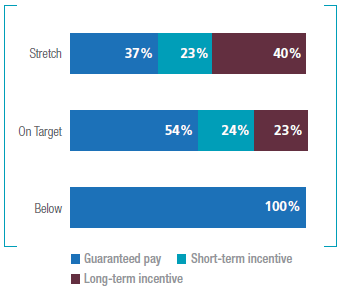
Executive management remuneration (%)
|
Executive management remuneration
To maintain a high-performance culture and an alignment with shareholders through value creation, the total reward mix for the Group CEO, Executive Directors, executives and senior management is geared towards a higher percentage of variable pay 'at risk' for achieving stretch goals.
The chart below represents the potential mix of guaranteed pay (GP), STI and LTI for the Group CFO1 at below, on-target and stretch levels. The below target assumes no STI payments.
Payments made to Executive DirectorsAntoine van Buuren – Group CEO The Group CEO does not participate in the LTI scheme.
|
Group CEO
|
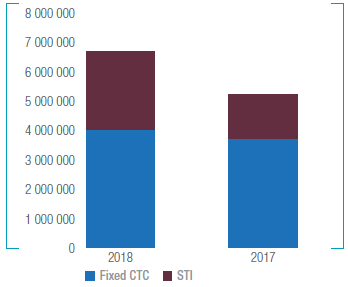
| 1 | Group CEO and Executive Directors participate only in the STI and not the LTI Plan. |
| 2 | Incentive pay-out calculated at 75% of the allowable bonus. |
| 3 | Relates to the FY2017. |
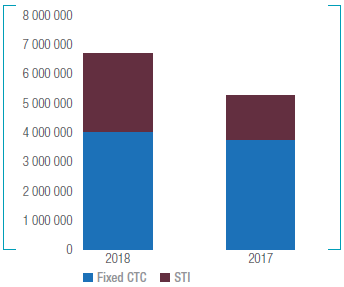
Willem Britz – Executive DirectorExecutive Directors do not participate in the LTI scheme with the exception of the Group CFO.
|
Executive Director
|
Hannes Boonzaaier – Group CFO
|
Group CFO
|

Termination of office payments
No payments were made on termination of employment or office of any members of the executive management.
Statement regarding compliance with remuneration policy
The Committee has satisfied itself that the remuneration policy as detailed in the report was complied with, and there were no substantial deviations from the policy during the year.
Advisory vote on the implementation report
The implementation report as it appears above is subject to an advisory vote by shareholders at the 2018 Annual General Meeting. Accordingly, shareholders are requested to cast an advisory vote on the implementation of the remuneration policy for 2018.
Approval of the remuneration report by the Board of Directors
The remuneration report was approved by the Board of Directors on 12 September 2018.