|


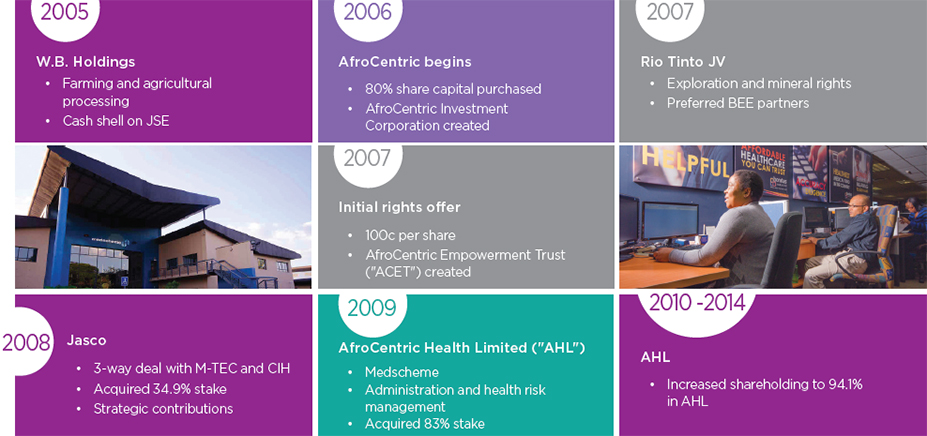
Currently viewing: Group profile / Next: Our global presence Group profile Organisational overview and external environment AfroCentric has built a significant asset and JV portfolio
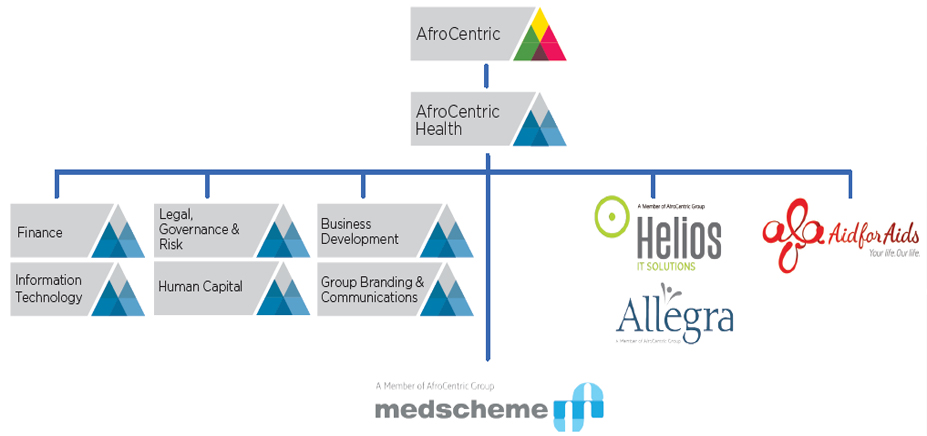
Our business model The Group’s growth and success can largely be attributed to highly efficient health administration, coupled with effective health risk management that ensures the sustainability of our client medical schemes and positions them for ongoing success. The strategy for the future is to continue focusing on our core healthcare competencies, using these as a platform to diversify and grow earnings through acquisitions, focused on the healthcare, technology and resources sector. Our business structure The AfroCentric Group’s most significant investment lies in its equity interest in AfroCentric Health. Accordingly, the Group profile has been provided at an AfroCentric Health level. The Group follows a “house of brands” philosophy and is therefore characterised by a series of companies with their own brands operating under an umbrella “house” brand, namely AfroCentric Health. The operating structure of the Group follows through from this “umbrella” approach and is reflected in the following diagram with Medscheme being the largest operating company in the Group.
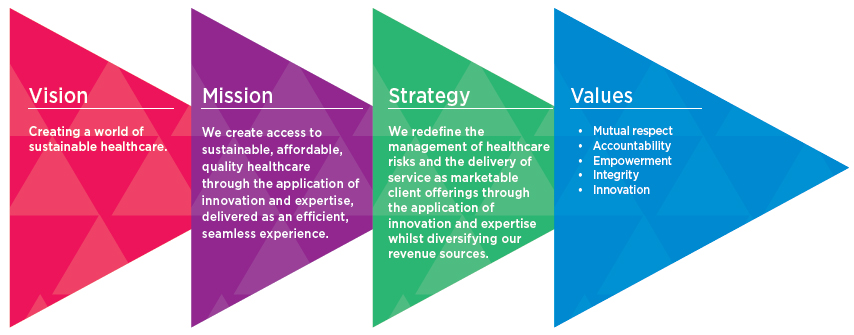
Our philosophy
Our products and services
Our external environment: What are the circumstances under which we operate? The macro-economic and legal landscape The economy-wide impact of the private healthcare industry The substantial spending in the private healthcare sector has an economy-wide impact on employment, household income, investment, taxation, education, international linkages and productivity. The sector’s trends interact with a number of economic elements and indicators such as the rate of employment, level of taxation and investment opportunities as well as training and development programmes. Various upstream and downstream industries are sustained and affected by changes in the private healthcare sector. Private healthcare users form part of the formally employed and their productivity is reflected in GDP growth. Research indicates a correlation between good health and productivity. A healthy productive workforce is therefore of national economic importance. Access to high-quality preventative and curative healthcare is essential to achieve this goal. Looking forward from a macro-economic perspective Both the government and private sector stakeholders should support the long-term sustainability of the private healthcare industry. Improvements made by Government to the quality of service delivery in the public health sector will not only increase the productivity of the employed population dependent on its healthcare services. It is likely to lead to greater patient choice which will stimulate price competition between the public and private sector leading to greater affordability. Building trust in the public sector will be critical. Current legal issues with a macro-economic impact The Protection of Personal Information Act ("POPI") This Act was signed into law by the President in November 2013. Subsequently, a few limited sections came into force on 11 April 2014, which relate to the establishment of the Information Regulator and the issuing of regulations. The majority of POPI will commence on a later date to be proclaimed by the President. Once the commencement date is proclaimed, companies will have 12 months to become fully compliant. According to Circular 6 of 2014, the Council for Medical Schemes ("CMS"), in consultation with the medical scheme industry, intends to develop a code of conduct as contemplated in Chapter 7 of POPI. The medical scheme industry has unique and particular features, which need to be explained and how the roleplayers in the industry would be able to practically comply with the provisions of POPI. The draft code of conduct will in due course be referred to the industry for further comments before it is submitted to the Information Regulator for approval.
The National Health Insurance ("NHI") white paper as well as the financing proposal developed by National Treasury, was complete and due to be tabled in Cabinet soon after the Finance Minister’s latest budget speech. The former Finance Minister Pravin Gordhan, reiterated the two pillars highlighted in the green paper upon which the 14-year implementation of NHI rested, i.e. improvements in the public sector healthcare delivery and the reduction in the high cost of private healthcare. The NHI pilot programme in some of South Africa’s most vulnerable districts is well under way and during the budget speech, it was announced that within the NHI component of the national health grant, R1.2 billion was earmarked over a three-year period to begin the contracting with general practitioners ("GPs"), develop new reimbursement mechanisms for central hospitals and improve their revenue management. It was reported that spending on GP contracting was low in 2013/2014 because of delays in reaching agreement on remuneration. Although many of the public facilities in the pilot districts face considerable challenges, slowly but surely there have been signs of progress. In the interim, the Minister of Health has had to deal with a number of incidents reflecting unfavourably on the public healthcare system’s delivery, but he has responded to these in a transparent and decisive manner. The energetic Minister announced an expansion of the free ARV treatment to those with white blood cell counts of below 500 per micro litre from a previous threshold of 350. In parallel, he has been actively campaigning against what he termed an explosion in non-communicable diseases at the source by targeting lifestyle habits that contribute to ill health. He has signed salt reduction legislation last year requiring the food industry to reduce salt content in processed foods. He aims to force cigarette companies to sell their merchandise in plain packaging by next year and his focus on preventive medicine has extended to a cervical cancer vaccination campaign aimed at female school learners. Commencement of certain sections of the National Health Act The National Health Act provides a framework for a structured uniform health system which takes into account the obligations imposed by the Constitution and other laws on the national, provincial and local governments with regard to health services. In terms of section 94 of the National Health Act, 2003 (Act No 61 of 2003), 1 April 2014 was determined as the date on which sections 36 to 40 of the National Health Act would come into operation. These sections contain provisions requiring all health establishments to obtain a certificate of need from the Department of Health by April 2016. On the advice of the state law advisors, the department of Health requested the President’s office at the end of July 2014 to withdraw the promulgation of these contentious sections of the National Health Act. This will allow the Department, in consultation with key roleplayers, more time to craft regulations that will bring the relevant sections into effect. Competition Commission inquiry The Competition Commission of South Africa launched a market inquiry into the private healthcare sector. The Terms of Reference for the inquiry had been published and a Statement of Issues and Administrative Guidelines was published for comment. The annual escalation of medical costs in excess of inflation is of concern and the inquiry aims to research the effectiveness of competition in the private healthcare market. The inquiry is to ascertain whether the market was functioning well. It intends looking into matters that could distort, prevent or restrict competition as well as concerns impacting the functioning of the market such as barriers to entry, regulatory or policy impediments. Participants in the inquiry will be expected to provide information on how the market currently functions and recommend changes to regulations that would increase competition. |

 NHI white paper
|
|
|


| AFROCENTRIC INTEGRATED ANNUAL REPORT 2014 |