|


Currently viewing: Business strategy / Next: Operational Review: AfroCentric Health OUR BUSINESS STRATEGY Our business strategy is aimed at redefining the management of healthcare risks and the delivery of service as marketable client offerings through the application of innovation and expertise whilst diversifying our revenue sources. The Group’s business strategy is defined at an AfroCentric Health ("AHL") level. The strategy provides the outputs to be delivered upon and AHL measures these outputs through various mechanisms. Key objectives have been determined for a three-year period.
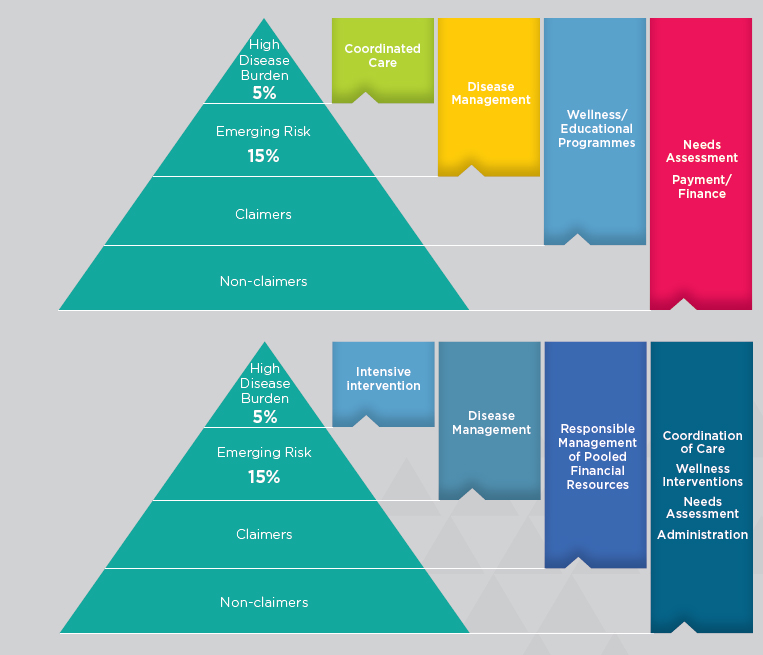
Evolving managed care strategy Medscheme aims to continuously decrease the medical inflation rate for its clients, while improving the quality of healthcare. This is achieved through a balanced mix of focused rules-based programmes, disease and wellness management, as well as provider networking and contracting initiatives. Medscheme offers an integrated and proactive approach to managing the cost and quality of healthcare through the optimisation of coordination of medical care in order to improve health outcomes and reduce excessive or unnecessary utilisation of healthcare services through an integrated population health risk management strategy. Some of the key areas of the managed care strategy are described below: Population health risk management Over the past year, Medscheme has expanded the sophisticated predictive tools used to identify high-risk members. In an industry first, Medscheme is able to identify with a high degree of accuracy, members who are relatively healthy but will shortly incur significantly greater healthcare costs. Interventions are then implemented for this specific population to address and mitigate the risks identified. Identified members are proactively contacted and educated on how to improve their health. Health coaching is supported with educational material that is sent to the members, coupled with a clinical treatment plan. The objective of the programme is to ensure that members improve their health, have a strong understanding of their condition and comply with their clinical treatment plan. Medscheme’s analytical ability to accurately identify at-risk beneficiaries enables us to target the managed care interventions appropriately, which greatly improves the efficiency of these initiatives. Coordination of care Coordination of care is a multi-dimensional concept and encompasses how information is shared between stakeholders in the healthcare value chain. The provision of healthcare services is distributed across a variety of distinct and often competing entities, often in the absence of a primary care practitioner ("PCP"). Poor coordination of care (fragmentation) not only makes care more expensive through ineffective, duplicative and unsafe practices, but results in poor outcomes and patient experiences. A key area of the Medscheme managed care strategy has been to focus on interventions aimed at improving coordination of care, which in turn has demonstrated to reduce healthcare costs. A number of opportunities to enhance care coordination have either been implemented or are currently being pursued including:
Partnering with healthcare professionals A key component of the managed care strategy is to develop strong relationships with healthcare professionals. Various engagement forums have been set up with healthcare professionals including the Independent Practitioner Association ("IPA") forum for the family practitioner, the Medscheme Specialist forum, and forums to interact with pharmacies and other related healthcare professionals. In addition, there is ongoing interaction with the different hospital groups. All these forums offer the opportunity to share information for the purpose of improving quality in healthcare delivery, as well as allow for engagement on cost issues, including the development of alternative reimbursement models. The objectives of developing strong relationships with healthcare professionals include:
Health analytics In addition to the identification of at-risk beneficiaries through predictive modelling, Medscheme’s health analytical strength has been effectively utilised over the past year in the following areas:
Medscheme was awarded a tender by the Road Accident Fund ("RAF") during the year to assist in clearing a portion of the considerable backlog in personal claims. Medscheme not only leveraged existing claims paying capabilities, but developed new expertise, processes and systems to cater for the specific RAF personal claims requirements such as merit and quantum assessments. As part of the RAF’s Project Siyenza, the Medscheme business unit had to be set up in an unusually short timeframe due to the client’s need to demonstrate early progress. Productive professional relationships have been fostered with RAF’s officials and regional offices which has allowed for significant refinement of processes. The initial contract is for a 12-month period, renewable annually. This contract has been an important diversification opportunity for AHL with its value not only in the additional revenue, but the ability to establish a track record in administration outside of its traditional client base and industry. Knowledge gained in the development of this business opportunity, whether implementation, processes or systems related can be applied in other new markets in future in both the public and private sector. Medscheme International has been very active in pursuing business opportunities in markets where Medscheme’s capabilities will add value, notably South East Asia and the United Kingdom where Medscheme’s expertise in managed care can be leveraged. Growth targets have been set for Medscheme International for the next three years with a clear mandate from the Board and Investment Committee to empower management to achieve the targets. AfroCentric Health Solutions has been actively pursuing opportunities in the rest of Africa and is in the process of concluding a transaction with a significant insurance player in the East African market through its associate AfroCentric Health Solutions Kenya.
Medscheme believes that our client medical schemes should dare to imagine a different future. This future includes better processes, a richer member experience, higher standards, and faster turnarounds. It is important to consider how we challenge orthodoxies and mental models to allow for innovative thinking, and to ensure we are always moving forward. ISO 2008:9001 certification is another major component of this strategy and our recertification for a further three years reflects our commitment to this objective. Strategic administration initiatives Adding value is a priority for us, and this can be seen in the strategic project streams that Medscheme has undertaken during the year in a quest for continuous improvement. Member-centricity initiatives Our overall goal is to create and maintain member-centric interactions and communications. Mandated objectives at a high level include:
Specific projects include:
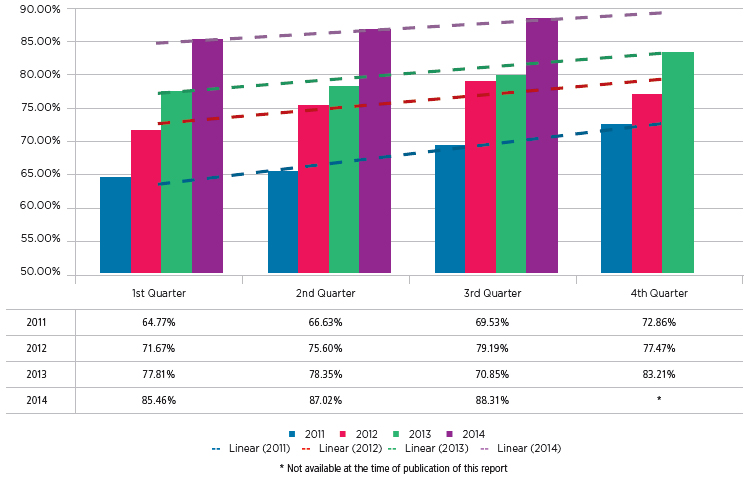
Our commitment to excellence is reflected in the marked improvement shown in the results of the ongoing Voice of the Customer ("VOC") surveys conducted by Medscheme’s Quality Assurance division. The improvement is clearly evident in the graph below, which compares the year-on-year results. Medscheme overall VOC score per quarter
Lean process management initiatives Our focus is on processes (the sequences of steps that are carried out to create value for our customers) rather than system development. By maintaining the process flow and striving for perfection, we can deliver greater value to members. This is part of our commitment to not only understand how our business satisfies customers but to also improve the effectiveness of how we do so. Key deliverables of the lean process management project are:
Fraud and wastage initiatives The primary goal of fraud, waste and abuse initiatives within Medscheme is to reduce overall scheme costs in order to make the client schemes more sustainable and price competitive – and subsequently, more affordable. The management of fraud, waste and abuse is highly dependent on changing behaviour in the market. This requires close cooperation from healthcare professionals and their representative groups and societies. Medscheme’s strong provider relationships are key to this initiative.
The consolidation taking place in the market through amalgamation presents an exciting opportunity for Medscheme and its South African clients to grow its market share, and we will continue to support our clients with the development and implementation of strategies that will position them to take advantage of this continuing trend. Diversification opportunities in the South African market are also being pursued. The successful award of the Road Accident Fund tender to Medscheme is evidence of this.
The successful execution of our strategy requires an innovative approach to healthcare risk management and the manner in which service is delivered to clients, brokers, healthcare providers and members. We maintain strong relationships with our clients and partner with them to develop and offer market-leading products and services to their customers to enhance competitive advantage. Medscheme continuously drives business unit performance to exceed contracted service levels and continually promotes a combination of high productivity and high quality in administration. Training is provided to ensure staff members perform business functions at their peak during enhancements of processes, systems and technology. Our people management processes support the recruitment process, training and career management of employees. Clearly defining personal development plans and succession planning is crucial to empower the employee base. This people-centric approach will become more important as our companies move into a new strategic environment. Supporting NHI AHL and the Group support the implementation of NHI and aim to seek solutions to aid the rollout of a sustainable healthcare system. We fully support the National Strategy of the Department of Health and will continue to align our internal and external activities to enable the achievement of these goals. The period it will take Government to build up the infrastructure and resources required to restore faith in public healthcare and to effectively implement the NHI is likely to take many years. The impact on the business of AHL is therefore expected to be gradual and focused on low income earners. Aligning Corporate Social Investment ("CSI") with NHI AfroCentric is fully committed to working with the Department of Health to create a sustainable healthcare system for South Africa and has committed resources for critical building blocks of an NHI system. In November 2012, Medscheme became a signatory to the Social Compact Fund, which was initiated to provide momentum to key objectives of the National Department of Health’s 10 point plan. By doing so, Medscheme committed a significant portion of its Socio Economic Development budget to the Fund. South Africa’s critical shortage of nursing staff is one of the most urgent components of building a meaningful NHI system to be addressed and Medscheme has focused its Enterprise Development in this area. Please refer to page 75 of the Sustainability – Corporate Social Investment section for details on the initiatives. |






|
|
|


| AFROCENTRIC INTEGRATED ANNUAL REPORT 2014 |